
February 2022 turned the Ukrainian city of Kharkiv into a place where time was no longer measured in hours, but in the distance to the nearest bomb shelter. For many couples, Russia’s full-scale invasion of Ukraine became the ultimate test.
“We were together 24/7. We even went to the supermarket together because the thought of being apart for even a second was terrifying,” Anna recalls. “Kharkiv was being heavily bombed back then, and the feeling that your person was beside you was the only thing keeping you going.”
By then, they already knew they were a family — although it had taken them more than a decade to fully understand it.
This story is part of the Everybody Loves Somebody campaign about real people from Ukraine, Moldova, and Armenia. And also about the fact that love doesn’t discriminate by gender or orientation. It simply happens.
“I didn’t like her”
Their story is nothing like a Hollywood rom-com about love at first sight. Back in the mid-2000s, they moved in similar circles: one had founded a nonprofit organization, while the other gathered women for casual hangouts near the Lenin monument, sending dozens of expensive SMS messages.
Yes, this is a story about two women. More than that — two Anyas.
The younger Anya was 16. She was part of the city’s alternative crowd — the so-called “hobbitka” in Kharkiv city center, which attracted hundreds of young people. She lived for the streets, the Zemfira fan club, and tried to organize women’s football games that somehow always turned into yet another hobbitka meetup. One day, another Anna showed up in their circle — ten years older.
“She showed up at our hangout talking about activism and stuff… and I didn’t really like her. I remember thinking, ‘Oh my God, what even is this?’ I was 16. I had absolutely no interest in activism,” Anya laughs.
The older Anna herself once didn’t see the point of institutional activism or NGOs either. Her journey began on internet forums back in 2005. “I didn’t even know words like ‘human rights,’ for example,” she says. “I had a background in psychology, and I started out simply helping lesbians and women in general by answering their questions online. It was very informal — I wouldn’t even call it counseling. And somehow, from there, things started to take off.”
In 2008, Anna and several like-minded women founded the nonprofit organization Sphere — the same organization she would later invite other girls to join, including Anya.
Their first meeting was a disaster. So was the second. Back then, Anya had turned 18, just got her driver’s license, and was cruising the streets of Kharkiv as if she owned them. Anna was nearing 30, deeply immersed in activism, already divorced and raising her little son. One day, the young driver proudly offered to give Anna and her kid a lift, but Anna just couldn’t trust a girl from hobbitka with her son’s safety. “She wanted her son to live at least a few more years,” Anya recalls the sarcastic reply. “Basically, she didn’t want to get in my car, and I was a little offended.”
After that, their lives drifted apart for another five years.
Everything changed in 2013, when they found themselves in the same group during a trip to Nikopol. One evening, they ended up alone together in a small house. And there, in that quiet little town, they actually talked for the first time. Another thing happened there, which, in Anna’s world, spoke louder than any grand romantic gesture: Anya — for whom her car was a symbol of freedom and personal space — simply handed her the keys and let her drive. “She was the first person who ever let me drive her car,” Anna remembers. “I thought: that’s a huge sign of trust. And it really worked.”
That day, they set off on a journey together.
A + A = Diversity
Anna is a visionary with strategic thinking. She remembers complex legal terminology and fights restrictive laws. She’s also the one who needs the house to be perfectly clean.
Anya is practical and action-oriented. Dust on shelves doesn’t bother her much because from the yard — where she can always find something to do — you can’t see it anyway. She is the driver who always knows the route and the handywoman who fixes electrical outlets.
“We’re completely different. We even like to relax in different ways,” Anya says. “I like being outside and walking around in the woods. But we found our balance: I take a knife and go mushroom hunting, while Anna sits in a fishing chair with a book and a thermos of mulled wine.”
Before 2022, their professional lives were completely different. Anna worked in human rights advocacy as president of Sphere Women’s Association and co-founder and board chair of KyivPride. Anya ran her own travel agency — until first COVID, and then the full-scale invasion brought the business to a halt.
Once it became clear that the war wouldn’t end quickly, Sphere saw a need to launch humanitarian programs. That was when Anya started volunteering for the organization, driving humanitarian aid across the Kharkiv region to elderly women. Gradually, she started working professionally on humanitarian programs and the Pride Hub community space. And just like that, they became not only a couple but a team.
The face of the community changed: many of the people they’d spent years bringing together had left, escaping shelling or fearing occupation. New women came to the hub instead — evacuees from territories even more dangerous than Kharkiv itself.
In a city where people are often afraid to leave home because of the constant danger, Anna and Anya continue doing everything they can, every day — for their community and for each other.
Another day comes to an end
In the evenings, when meetings and reports are finally over, they return to being simply two women in one room. Their shared space fills with the sounds of Ukrainian stand-up comedy and podcasts. Anya is carefully carving something from wood — she learned to carve as a way to calm her nerves in a city shaken daily by explosions. Nearby, Anna is painting by numbers.
Their domestic life is built on small exchanges of care. Anna loves cooking delicious meals for the woman she loves. Anya, in return, always handles the dishes.
They’ve been together for nearly 13 years.
And yet, despite that profound connection, a shadow creeps into their relationship now and then. Since the full-scale war began, it has taken on a new shape. It’s the shadow of vulnerability — physical, legal, financial. It cuts sharper than any carving knife. When bombs are destroying homes around you, the question of “what if” stops being hypothetical.
“If something happens to her, I have no rights,” Anna says quietly. “And not just because I’d be forced to leave the home we’ve shared for 10 years and end up with nothing. But even the memory itself… I believe we’re close enough for me to have a say in how Anya should be remembered. But I won’t be able to do that.”
For nearly 13 years, they have raised a child together, built a home, tended a garden — and yet, in the eyes of the state, they remain strangers. But love doesn’t wait for legalization. It simply happens to us.
“Anya once read somewhere — or maybe saw a reel (let’s be honest!) — that you realize whether you truly love someone in a single moment: when you come home, walk into the yard, and see that their car is already there. What’s your first reaction? I’m always happy when I see her car,” Anna admits. “That’s my personal test: after all these years, I’m still happy to see Anya.”
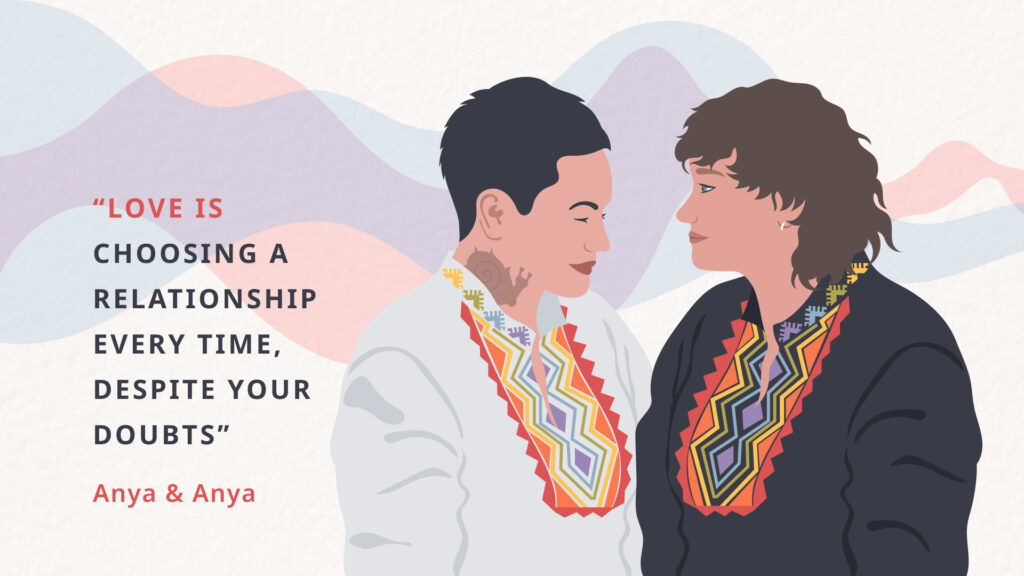
Like any couple, they have moments of tension and doubt. Anna openly says: “I doubt myself all the time. I’m still very insecure.” She often asks her partner whether they’ll stay together, whether she might find someone else tomorrow. And every single time, year after year, Anya answers with the same warmth and patience: “We’ll be together. Don’t worry.”
Because love is choosing each other — every day.
And if you’ve ever loved someone, you’ll understand.