
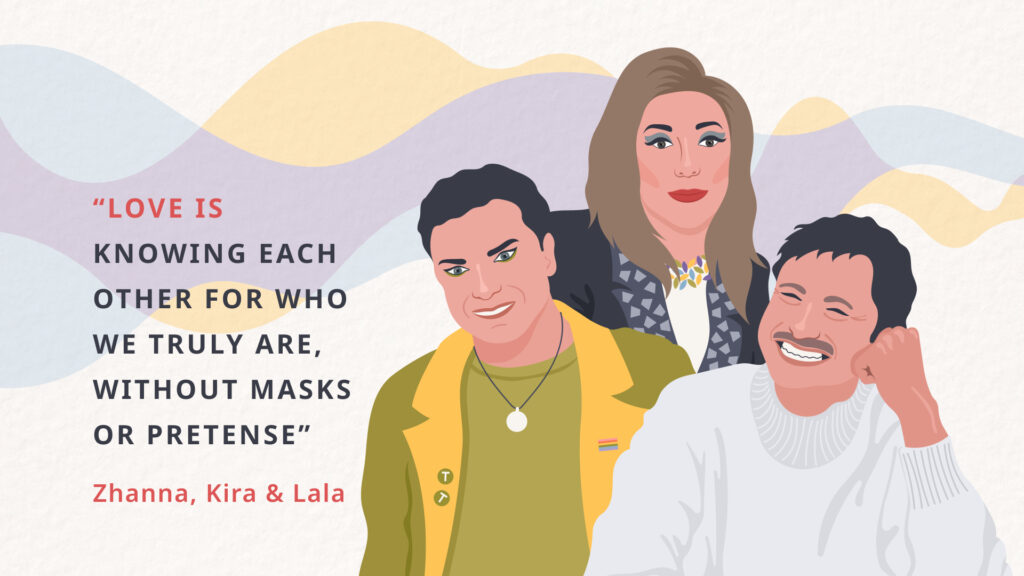
Zhanna, Kira, and Lala have known each other for almost 15 years. They were brought together by the stage and transformation. Over time, solidarity and shared values grew into a strong, mature friendship. And now, when Lala talks about their friends, they say this: “We know each other without masks, without makeup.” Of course, this is not only about their stage personas.
This story is part of the Everybody Loves Somebody campaign about real people from Ukraine, Moldova, and Armenia. And also about the fact that love means accepting others for who they truly are.
“Well, sisters, shall I start?”
Kira Vazovski knew from childhood that she wanted to be on stage. When her mom left for work, she would put on her robes. Not because she wanted to be someone else — simply because it was beautiful. Many years later, in 2012, she would step onto a stage for the first time, face her first audience, and realize that it’s possible to communicate something to people. Change something. Kira is 40 years old now, and she continues changing this world.
Alexey got a job as a barman at the café Kapriz. One day, someone joked: why not a barwoman? That was how Lala Impeachment came about in 2013. However, a few months later, Alexey put her “back on the shelf.” Until, two years later, Zhanna called and said: there’s going to be a festival — come.
Zhanna Simeiz started performing in the mid-1990s — a time when going on stage as a female character was not only shocking, but truly daring. Behind her were ten years as a headliner and art director at the most famous gay club in Kharkiv, a place visited by people from all over Ukraine. And another ten years in Ukrainian Crimea — at the club Yozhiki in Simeiz, a small settlement on the southern coast where every summer people gathered from across the former Soviet Union.
“You know how dolls are allowed a little more liberties than ordinary people,” Zhanna explains. “If the character is thought through, properly made, the character is allowed more. Those were the times when you could get punched in the face for this. But Zhanna Grigoryevna walks out like that — so this lady must believe in something. There’s something about that lady.”
She knew what a real character looked like — and she could immediately tell when there was something alive behind the appearance, or when a person had simply “come out to look pretty.”
Back then, most performances were built around lip-syncing — performers mouthed someone else’s songs and the audience applauded. Zhanna did things differently: she talked to the audience, read erotic poetry from the stage, performed stand-up. For her, the stage had always been a conversation, not just a picture: theater should offer hooks, something to think about, something to ask.
So when she once heard that somewhere in Kharkiv “some Kira was jumping around, and there was some Lala with her,” she went to watch with skepticism. But on stage, Zhanna saw a person singing live and speaking to the audience. That was rare. And it was enough.
Bonds
In 2011, Zhanna created a festival. She called it Buzkova Mana — “Lilac Mirage.” At the time, many people wanted to try themselves in drag performance, and the festival became an entry point for them. Kira came as a participant — and won the audience choice award. Zhanna invited Lala personally: “There’s going to be a huge festival, why don’t you come? You’re good at it — come on.”
Then came Zhorzhynove Dyvo (“Dahlia Miracle”) — this time on a proper stage, with decorations, the way it should be. And gradually the festivals became something bigger.
For a long time, Kharkiv had no hubs, no organizations, no safe spaces for the LGBT community. There was only one club, and people went there not just to dance, but simply to be among their own. Zhanna, Kira, and Lala understood this better than anyone. Because they themselves had gone through it.
Kira opened the club not so much as a business, but rather to give people a place to meet, talk, and feel free. Sometimes the venue would open, then close, then open again. There were always performers nearby who shared the same values, and gradually an entire community formed around Kira, Zhanna, and Lala.
Over the years — first in Kharkiv clubs, then in Simeiz — Zhanna had, in her own words, “raised” people who are now in their thirties. She knew everyone personally. She saw people coming for the first time and not knowing what to do with their hands. For many of them, the club was the first place where they didn’t have to explain themselves.
“I know that if I say: tomorrow we’re meeting in front of the city hall to show who we are and what we stand for — 70% would come,” says Zhanna. And that’s not boasting. It’s the result of many years of real dialogue between the people on stage and the people in the audience.
Lala sang in Kharkiv’s first LGBT choir. Then in the second one, which grew out of the first and was called Queer Essence. The choir wasn’t only about music either: it was another safe space where members of the community could sing and express themselves together. Rehearsals, concerts, trips to Kyiv — all of this continued right up until February 2022.
“Sometimes Lala is in a suitcase. I can exist without Lala, but Lala can’t exist without me,” Alexey explains.
In 2017, Zhanna called her friends and said: we’re going to KyivPride — onto a platform, in full drag, in the center of the capital. It was the first time in the post-Soviet space that drag queens appeared at a political march. The friends understood that it could be dangerous: they could be booed, hit with a brick, dragged out of the procession. But they took the risk and showed that they exist and also deserve equal rights.
The Ukrainian drag queens were featured by Radio Free Europe/Radio Liberty and BBC, as well as in the British tabloid Daily Mail.
Zhanna recalls feeling like a target for those thirty minutes on the platform — but her friends were beside her. This is the hallmark of friendship: the ability to stay beside each other in struggle and in routine, in pride and in weakness.
“When you’re feeling bad, you call them. And when you’re happy, you call them too, just to share the good moments. And that’s the main thing. These people are there for you not only when things go wrong, but through good times and bad,” says Kira.
Everyone lived in Kira’s basement
Zhanna left for Lviv two weeks before Russia’s full-scale invasion of Ukraine. “I went there not because of the threat — just for work. I was horrified, because on March 2 my apartment was destroyed, then Lala’s apartment was destroyed. Kira’s apartment burned down, her costumes burned too. I called and asked: where is everyone? And they told me: ‘They’re all living at Kira’s place on Alchevskykh Street.’”
17 Alchevskykh St. is the address of the bar Kaktus. At different times, the space was also home to Barsuk, Al Cafe, and Red Room. The landlords left the country, and the owner gave the green light: let neighbors come, let friends come, since there’s a safe space in the basement.
“We lived there for several months. When it was very, very scary,” says Kira. Lala specifies: until around autumn.
Meanwhile, Zhanna set up a transit point in Lviv.
“At the time, I was also working in a food service spot, and we made a kind of shelter there: we welcomed people, just ordinary people, and I helped them get from Lviv to Poland for free. At the beginning of the war, there were huge numbers of people in Lviv and at the borders. I kept telling the girls — come here. But they stayed in the basement.”
When her husband received a deferment from military service to care for his father, Zhanna said: let’s go home — to Kharkiv, to the sisters.
Mutually beautiful
Fifteen years is a long time. Long enough to get disappointed in someone, drift apart, forget each other. With Zhanna, Kira, and Lala, the opposite happened.
“They say a friend is someone you can go half a year without talking to, and then… you call them and pick up the conversation exactly where you left off six months earlier. That’s very true… I always think about Lala whenever something happens in Kharkiv. How is Lala doing? I know her apartment is destroyed. I see an opportunity to apply for some grant program — I pass it to Kira, because she’s constantly dealing with these venues, even though her own house is wrecked. You know, one of my friends once said: ‘If not us, then who?’ Kira is doing her thing, and Lala is doing theirs. And it’s fascinating — and there are people.”
“Lala and I can just go out to Hydropark, we see each other very often. Denis (Zhanna) has come back now, so Denis and I will be seeing each other more often,” says Kira. When asked what makes these relationships special to her, she answers: “Honesty. Honesty with yourself. Honesty with your colleagues. And warmth. That’s what I think. Yes. Trust, sincerity.”
“These relationships matter to me because they’re real. We know each other without masks, without makeup. And there are certain questions you simply wouldn’t discuss with anyone else,” says Lala.
Lala has no family nearby: “I was a late child, my father and mother are both gone now. I have an older sister, but unfortunately she’s currently in Belgium on temporary residence. [Suppose] I end up in the hospital. In intensive care. Then what? Who would they call, and who would they even let in?” Lala asks anxiously.
In Ukraine, there’s still no civil partnership or anti-discrimination law. For Zhanna, among other things, this also means no protection against hate-motivated violence. All these years, the friends were doing more than just putting on shows. In this way, they continued fighting for equal rights, for the possibility of simply being themselves: by creating communities, supporting one another and other people, stepping into the frontiers in wigs.
Friendship is one of the most sincere and pure forms of love. The kind of love that gives people the strength to be themselves and continue standing up for what matters, even in the hardest times.
“Don’t be afraid of anything. ‘Keep fighting — you are sure to win!’* Yes, it’s difficult, it’s hard. Yes, these are terrible times. But move forward boldly. Go ahead, learn, ask questions,” says Zhanna. “And most importantly — act. Remain human beings and ‘be mutually beautiful,’ as the Ukrainian poet Lina Kostenko says. People, be mutually beautiful.”**
* A quote from a poem by Taras Shevchenko: “Keep fighting — you are sure to win! God helps you in your fight! For fame and freedom march with you, And right is on your side!”
** A quote from a poem by Lina Kostenko: “And if it were my will, I would write everywhere in italics: There is so much grief in the world, people, be mutually beautiful.”