
“If it weren’t for my child, I probably wouldn’t be where I am now. My life wouldn’t have turned out the way it did,” Alina says. She is 48, a psychotherapist. Sitting next to her is Zhenya, who changed her more than Alina could have ever imagined when she became a mother on November 20, 2003.
This story is part of the Everybody Loves Somebody campaign about real people from Ukraine, Moldova, Armenia, and their love that simply exists.
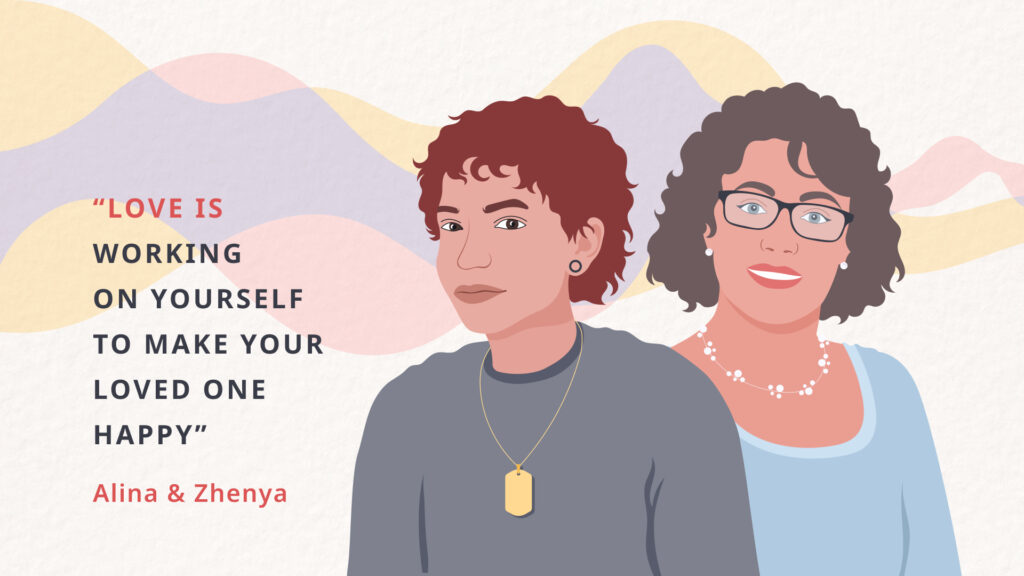
Before Zhenya understood he was Zhenya
“My child was very different from other kids from a very early age. I could see that. It wasn’t easy for me,” Alina says. “On the other hand, I believe that both my professions grew out of motherhood — me as a breastfeeding consultant and as a psychotherapist. My life turned upside down.”
As a child, Zhenya was the kind of kid you could give a toy to, and he would just sit and play. Very calm, very immersed in his own world. But things weren’t that simple: “If he made up his mind about something, if he needed something — it didn’t matter what my intentions were, or whether I needed to go in a different direction. He needed it his way. And we could all break ourselves trying, but everything had to be the way he decided. If he didn’t want to study or wasn’t interested in something, he simply wouldn’t do it — even if everyone around him really needed him to.”
Zhenya himself speaks about his childhood briefly, because he doesn’t remember much. He had to deal both with neurodivergence and with exploring his gender identity: “For some reason I knew from childhood… I didn’t want to hang out with girls. I never really asked myself why — probably until 12, when puberty started. After that, something started to break. I was trying both to fit in and to stand out. I understood that something was bothering me, but I didn’t know what. And I noticed that the girls around me were different — and I still felt closer to boys. It was strange.”
Fear, guilt, and autonomy
Neither of them can pin down the exact moment when everything changed. Alina says it was probably at the age of 15–16. Zhenya shrugs: something like that. There wasn’t any dramatic conversation at the table. It all came together gradually — through hints, through conversations like “this is how I feel.”
Zhenya remembers the day he decided to tell his mom what conclusion he’d reached: “I was nervous just for the sake of it. Because I knew everyone gets nervous.” He knew his mom would accept him, because trust between them had been built long before that moment.
Still, it was hard for Alina:
“As for my reaction — I wasn’t exactly calm, balanced, or rational. No. I went through a long process of denial. I thought it was temporary, just some teenage phase. And honestly, for quite a long time I felt a lot of guilt — maternal guilt. I felt like it was somehow my fault, that I hadn’t done something, that I’d done something wrong. And that it was the result of my mistakes.”
She also felt fear — not for herself or “what people would say,” no:
“I was really worried about how my child’s life would turn out. Because I understand that being transgender isn’t something that’s easily accepted in society. It’s a process that requires adaptation — both for my child and for our whole family.”
Her journey to acceptance took some time. She talked a lot with her friend who’s a specialist in this field, attended parenting conferences, read books, and interacted with LGBT people more and more — first as a mother, later as a therapist. But, she says honestly, the real turning point wasn’t that:
“A lot of difficulties were related to mental health — both my child’s and mine. I felt better after I worked through mine. I simply had more strength. And when I began to understand my child’s mental health, it became clearer what to do.”
For Zhenya, that period was also about something more than identity. He was going through what all people go through — the urge to grow up quickly and anxiety that inevitably casts a shadow: “I was afraid of becoming an adult. I had that teenage impulse. You do adult things, but you’re still a child.”
At some point, Alina realized: the more she tried, the less it helped. “The amount of effort I put in doesn’t correlate with the result at all. If I keep hitting a wall very intensely — there’s still no result.” So she stopped and reframed her role: “When I understood that a parent’s task is to help a child become autonomous, everything changed. If I keep treating him as if he’s a fragile vase in my hands, it won’t help him. So everything I did from that point was connected to one thing: I help my child become more autonomous. Or I don’t.”
And gradually, things started to change. Zhenya’s friends began coming over. Different people, different stories.
“All the friends my child has have been to our home at different times. I never went into details about how close they are or what their relationships are like. If my child wants to tell me, he tells me. If not, he doesn’t. It meant a lot to me as a mother. Different people from my kid’s social circle are comfortable coming to our home, they don’t feel awkward, they introduce themselves with the names they want, they ask to be addressed with certain pronouns. There is no feeling of ‘I’m the mother, you should talk to me in a special way.’ No — we had very horizontal, equal relationships. I liked that a lot.”
Full acceptance, Alina says, came about two years ago. She doesn’t remember the exact day — only that at some point she realized she no longer thought she’d done something wrong, and no longer worried that her child wouldn’t find his place. It took a long time.
“I was lucky”
Today, Alina and Zhenya are two adults who seek help and support from each other.
She says she’s almost jealous of herself in this regard: “Not many parents have the kind of relationship with their 20-year-old child that I have with mine. We don’t really argue, we don’t fight, we respect each other’s boundaries, we know how to negotiate, and we understand each other very well.”
“For me it’s very important that my mom is very good, very kind,” says Zhenya. “I know that not every parent is understanding and trying to really connect with what you’re interested in and help you with it. The older I get, the more I want to be like my mom — because I don’t just see you as my mom, I see a successful person, a woman. And that’s very important to me. I want to be as successful as my mom one day. And then, if anything happens, to help my mom.”
For Alina, the most important thing is that the first person her child will turn to is her: “Maybe not the only one, but I know for sure — the first. And he won’t be afraid to ask me any question or ask for any help. Even if he thinks I might refuse — and that happens sometimes. I know he can handle it, and it won’t break our trust.”
The person you gave birth to
At the end of the conversation, Alina speaks not to the camera, not to the interviewer, and not even to her son. It’s as if she’s speaking to someone specific — a parent sitting somewhere right now, not knowing what to do with what they’ve just learned about their child:
“If your child has come out to you, or you’re thinking this might be the case with your child — try to imagine how scary it is for them to tell you, if your attitude is strongly negative.
Second: try to imagine that this won’t go away. And your attitude toward this situation can strongly affect your relationship with your child for the rest of your life. And this is the person you gave birth to.
Imagine that if your child can’t bring and share such an important and sensitive part of their life with you — they’re unlikely to share other joys and sorrows of their life. And you will most likely lose contact. But that’s just your child.”