Lenacapavir Evaluation of Acceptability and Preferences Study. Quantitative and qualitative data on HIV prevention and long-acting PrEP among key populations and healthcare providers in Kazakhstan, 2026.
To our knowledge, LEAP is the largest dataset in Eastern Europe and Central Asia that covers not only PrEP use and experience but also attitudes towards and preferences for long-acting PrEP. It was collected just as long-acting options are entering the regional agenda. Much more can be learned from it than our own team can publish, and we invite researchers and partners to propose their own analyses.

Who this is for:
- Academic researchers and students
- Community-based organisations
- Public health agencies and programme planners
- Industry partners
What we offer:
- De-identified quantitative data for the variables your project needs
- De-identified interview and focus group transcripts
- A study team with deep knowledge of the local context
Numbers and voices from the same study
LEAP combines a national online survey with in-depth interviews and focus groups. Its central question is how acceptable twice-yearly injectable lenacapavir would be for HIV prevention in Kazakhstan, and what would help or hinder its uptake. Along the way, it documents HIV and STI testing, oral PrEP use, experiences in healthcare, stigma, mental health, and information needs.
Quantitative data
Cross-sectional survey, 16 June to 31 August 2026
Anonymous online survey of HIV-negative or untested adults living in Kazakhstan who belong to at least one key population. Participants were recruited by peer outreach workers in several cities and through online community channels, peer networks and dating applications. Before the questions on acceptability and preferences, every participant read the same standardised information about lenacapavir.
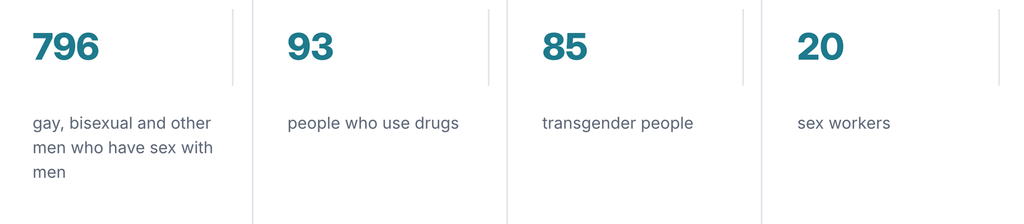
Participants by key population (participants could belong to more than one group)
Qualitative data
75 interviews and 6 focus groups
In-depth interviews were conducted in Russian in Almaty and Astana between March and June 2026. Before the main part of each interview, participants read the same standard information text on lenacapavir, so accounts can be compared across groups. All interviews are fully transcribed. Researchers are free to analyse the material with any theoretical or analytical framework of their choice.
Topics covered:
- Everyday experience of healthcare
- HIV prevention practice and oral PrEP history
- Prior awareness of lenacapavir
- Views on the product and the six-monthly regimen
- Partners, community and stigma
- Health services and structural conditions
- Proposals for implementation in Kazakhstan
Provider interviews add the view from the clinic and the policy table, so user and provider accounts can be read side by side.
What LEAP offers that other datasets do not
LEAP is a single-country study. That is a deliberate choice. It trades breadth for depth on the questions that matter now for long-acting PrEP in the region.
- Built for long-acting PrEP.
Acceptability, willingness, willingness to pay with and without a government subsidy, and delivery preferences for twice-yearly lenacapavir, asked after standardised information. Large multi-country online surveys in the region still ask only about oral PrEP. - Four key populations in one instrument.
Gay, bisexual and other MSM, transgender people, people who use drugs and sex workers answered the same core questions, with dedicated modules for each group. Most regional surveys cover men who have sex with men only. - Recruitment beyond dating apps.
Peer outreach workers in several cities recruited alongside online channels, to include people who are not reached through dating applications. - Numbers and voices together.
Survey data sit beside 75 interviews and 6 focus groups with the same populations, so findings can be explained and not only counted. - Users and providers.
25 interviews and 2 focus groups with healthcare workers and policy actors show how the health system sees what users ask for. - National depth.
Participants from 20 cities and regions, in Kazakh, Russian and English, give a picture of one country in detail instead of a thin slice of many. - Current data.
Collected in 2026, ahead of national decisions on introducing long-acting PrEP. - Transparent documentation.
A full variable manual with every routing rule and a clear distinction between questions not shown, not reached and not answered. - A local team as partners.
Co-authors with years of work in the region and with these communities, who know what the numbers mean on the ground.
How to collaborate
- Get in touch. Write to the study team with a few lines about your idea. We will reply with the concept note template.
- Choose your variables. Consult the variable manual on the ECOM website and list in the template the variables or qualitative material you consider relevant for your research question. We do not share the full dataset. You receive only what your project needs.
- Submit the concept note. Research question, data requested, analysis plan, team and timeline. The concept note is reviewed and approved by the Technical University of Munich.
- Data transfer agreement. A data transfer agreement is signed before any data are released. It sets out data protection, perm storage.
- Receive the data and write. You receive the approved de-identified variables or transcripts. The study team remains available for questions on context and variables.
Interested?
We welcome early, informal conversations. An idea that is half-formed today can become a strong paper with the right data behind it. Contact: Nikolay Lunchenkov, nik@ecom.ngo.