
In Sergei’s desk drawer there was stationery — mom would always buy it in advance. One day, his sister Tanya needed a fresh notebook. She opened the drawer and found one — the prettiest. Inside were some notes: a story about catching each other’s eye and other romantic moments. At some point, the girl stumbled upon pronouns — “he,” “his.”
She closed the diary and forgot about it. Or almost forgot.
This story is part of the Everybody Loves Somebody campaign about real people from Ukraine, Moldova, Armenia, and their life-changing love.
Rîbnița
That’s the name of a small industrial town where Tanya and Sergei grew up. It’s located in the so-called Pridnestrovian Moldavian Republic (Transnistria) on the territory of Moldova. Sergei is the middle child, Tanya the youngest of three. They’re one year and ten months apart, though Sergei always rounds it up to “two years.”
They lived like many other siblings of that time: fighting with pillows, dividing chocolate bars down to the millimeter with a ruler, watching TV. There was no internet back then, so the amount of information about the world was exactly what you could gather in a small town. Some things Sergei and Tanya simply didn’t know, because Rîbnița didn’t even have words for them.
They share one childhood memory. They were at their grandmother’s village and climbed a mulberry tree for berries. Suddenly Tanya saw a huge beetle and panicked. Sergei didn’t have time to react, so he fell first, and then his sister landed on top of him.
“A soft landing,” Tanya laughs.
As the children grew up, it became more painful to fall. In his teenage years, Sergei fell in love — with a neighbor from another building, two years older, a tall basketball player. “I fell so hard for him that I just decided to confess,” Sergei recalls. “I went to his house and said: ‘I love you, I’ll explain everything later’ — and ran away.”
After that, he was sick for a week. “Emotionally it was such an enormous shock that it just knocked me down. I understood this was something that basically didn’t exist in my world.” When he got better, he talked to the neighbor and lied that he’d said it because of a bet. That’s how his first love ended.
Soon after, Sergei grew up and went to study in Chișinău. His older brother Vanya helped him settle in. Later, when Tanya’s turn came, it was Sergei who helped her.
A different world
Different people, different subcultures, access to information — what Rîbnița never offered existed there. “Before moving, I didn’t have a computer or anything,” Tanya says. “Only TV, radio, newspapers. After moving, I got internet access — you could search for whatever you needed. And there was a much more diverse youth community. So many young people from different subcultures, with different ideas and interests.”
For the first time, she found herself around openly queer people — just as part of everyday life. Sergei watched how his sister reacted to this new reality, how her worldview changed. One day he gathered courage and told Tanya he was bisexual.
“I first said I liked both boys and girls, to make it less shocking,” Sergei explains. “It’s still a sensitive thing — you don’t want a close person to reject you. So you try to ease them into it gradually. But I think it can actually be harder for us, people from the community, to come out than for others to hear it. We carry a lot of childhood trauma. We think we won’t be accepted, because in Moldovan society there’s this atmosphere of rejection. There are so many hostile voices. And you’re afraid some of your loved ones might not accept you either.”
For Tanya, it felt like something about freedom, about being open-minded and progressive. By then she’d already suspected something, but subconsciously denied it anyway. That old Sergei’s notebook was still somewhere in her memory.
On Dumbledore
When Sergei finally came out, Tanya didn’t know how to react. “I was very, very surprised,” she says. “But I tried… not really to support him. I didn’t even know how to react. You never really know how to react. What helped me was probably his environment — he already had many friends who knew. And Sergei himself didn’t change for me. He’s my brother. Before and after, he was the same — caring and brotherly.”
Still, it was difficult for her. She needed to share it with someone. “No matter what, it’s a stressful situation,” she explains. “It doesn’t mean it’s bad or good — it just throws you off balance. I asked Sergei if I could tell my friend. He said yes, of course — she’s your friend. I try to be open with people when I can.”
Tanya sat with her friend, going over facts and memories, trying to fit this new knowledge against them. At one point, her friend said: “Oh, that’s why he defended Dumbledore so much!” (Back in 2007, the whole world was debating whether the great wizard could be gay.)
Carpe diem
After some time, Sergei introduced Tanya to his partner. “When I feel I’m in a serious relationship, why not introduce my sister,” he says. “She gets to know the people in my life, and it matters to me that someone close knows who I love.”
They have their own language — small gestures. Sergei might suddenly show up at Tanya’s place with a bouquet of lilacs for no reason. When he was moving to Sweden for a year and a half, Tanya signed an old childhood photo of the three of them for him as a farewell gift.
This year, Tanya and their brother came to wish Sergei a happy birthday at midnight — he wasn’t expecting it. She’d made a collage of photos: childhood memories and bright moments. “That collage is still hanging on my fridge,” Sergei says. “Every time I walk past it, I feel warmth. It means a lot to me.”
Tanya has a special love for photography. Sergei smiles and says she even makes content at the family summer house. When she had her final review at university, Sergei came. “I was very nervous,” Tanya says. “He came to support me. It wasn’t even an exam, just a final review — but he was there. And it meant a lot. It really pushes me to keep going, to develop, to do something that makes not only me but my loved ones happy.”
It was because of him that she started traveling. “It was very difficult, there weren’t many opportunities,” Tanya explains. “But Sergei always inspired me: you can try, don’t miss your chance. Better to do it and regret it than regret not doing it.” She also flew to the United States thanks to him. “The whole world should know about it,” she laughs.
Sergei, in turn, says his sister taught him something else — to notice small joys. “I tend to be more focused: work, sports,” he says. “And she’s more easygoing about things that don’t really matter. She looks for small joys. She taught me to appreciate them.”
“What’s special about your relationship?”
the interviewer asks at the end of the conversation.
“We know we’re blood,” Tanya answers. “And whatever happens, we always come back to each other. There’s only mutual support and inspiration between us. And we accept each other’s differences. We understand that he has one way of seeing life, I have another. And there’s no need to insist or impose your opinion. It’s all completely free, easy, and effortless for us.”
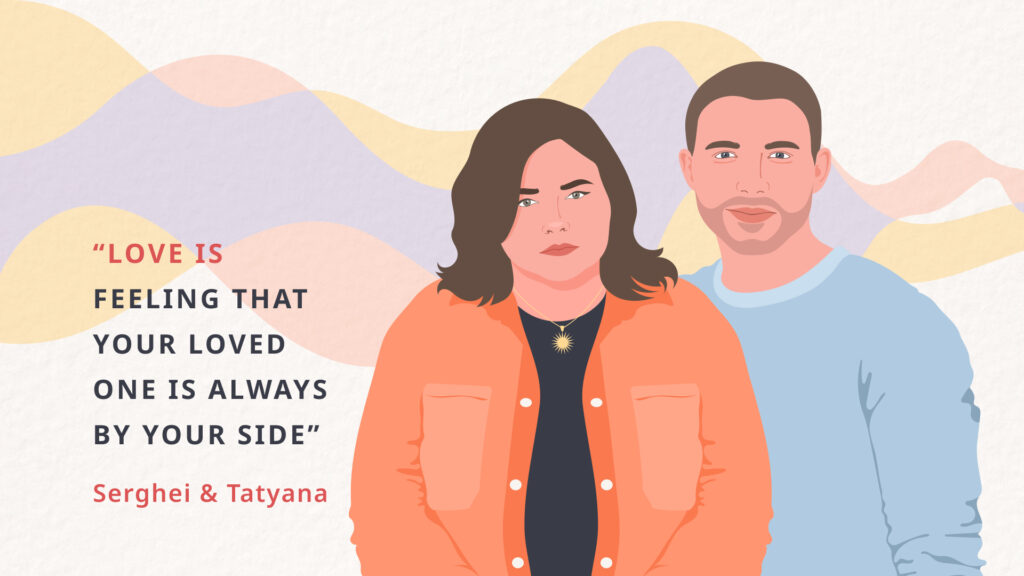
“You feel that this is your person, regardless of how often you see each other or how far apart you are,” Sergei says quietly. “And that feeling is precious: that somewhere out there, just one message or one phone call away, there’s someone who’ll always support you and stand by your side.”